
The Indian Premier League (IPL) 2026 has officially begun, and the craze among the fans is at its peak. However, a significant shift from its origin as a cricket league or sporting tournament has been noticed in recent years, where it is now perceived as the biggest marketing platform for brands. This is because the 60-day-long tournament, or the “National Festival of Consumption”, would not only bring visibility and engagement, but also real outcomes.
Also Read: Indonesia: 7.4 Quake Near Ternate Kills 1, Tsunami Warning Lifted
IPL is the Trendiest/ Successful Marketing Ecosystem
Since its inception in 2008, the IPL has developed from a mere cricket league to a fully developed, successful marketing ecosystem. Its role is not limited to just acting as a ‘gravity well’ for consumer attention, but also bringing outcomes.
Notably, the Indian Premier League pulls over 1.8 billion viewers (per FICCI EY report) across TV, social media platforms, and streaming sites like JioHotstar. With such a massive audience, which is growing every year, the brand’s CMOs cannot just consider it a campaign window. Instead, it’s a brand-building season, running for over two months and 74 matches, which can make them turn a consumer into a customer.
And many brands are already doing it, from aviation (Etihad) to AI (Google Gemini) and quick-commerce (Zepto). Reports from the exchange4media reveal that the leading franchises like the Mumbai Indians, Chennai Super Kings, and others manage a portfolio of 30-40 brand partners.
Interestingly, this clutter is the ecosystem IPL teams are building and integrating into the teams, viewed by crores of people.
IPL Shifts From Passive Ads to Brand Experiences
In contrast to the beliefs of reduced pricing this session, IPL ad rates have increased significantly for the brand to gain that “10-second interruptive spot,” And the reasons behind that are quite simple, as this 2-month-long tournament is just not featuring passive ads but an entire brand experience.
| Platform | Format / Metric | 2025 Rate (significantly increased for 2026) |
| Linear Television | 10-second Spot | ₹18 – 28 Lakh |
| Connected TV (CTV) | 10-second Spot | ₹7.5 – 8.5 Lakh |
| Connected TV (CTV) | CPM (Standard) | ~₹480 |
| Connected TV (CTV) | CPM (Premium Matches) | ~₹650 |
| Mobile Streaming | CPM | ₹250 – 340 |
Also Read: Nuwan Thushara Files Case for IPL 2026 NOC, Royal Challengers Bengaluru Spot in Doubt
Notably, Brand now prioritizes “Mental Availability”, not just the viewer reach, which is already a highlight since it brings 1.8 billion viewers. Out of this, 80% of fans watch on a smartphone, also called a second screen. With this, fans are reacting, sharing, and participating in real time, and brands are using the Multi-Screen Conversion Architecture to gain measurable returns with IPL.
They can simply drive the purchase through ‘Buy Now’ prompts, real-time push notifications, and other Tactical timeouts like a 10-minute delivery discount or more. Not only that, TV and CTV also serve as a perfect tool for these brands to build an emotional narrative and trust.
Perfect Case of Brand Experience
Confetti built a perfect marketing brand experience case for Etihad Airways. They focused smartly away from just adding exclusive or IPL special tags and instead created custom “boarding passes” for star players, symbolizing a journey to the finals.
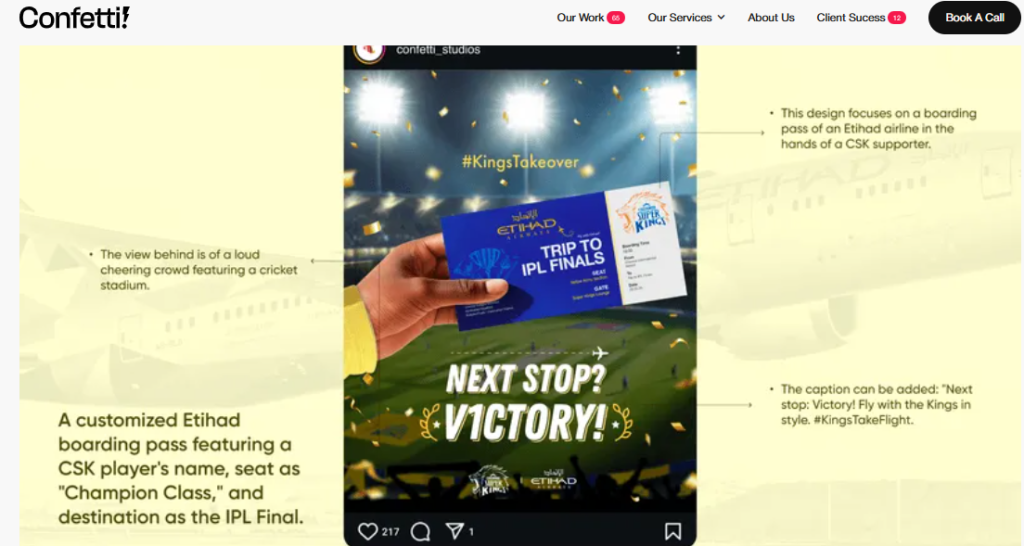
Additional taglines, smart visuals, and others made it a memorable ad for viewers.
Another example is the Jio, which integrated its 5G narrative by showing fans “living room match setups.” With this, they are not selling just the data plan but the lifestyle of a high-speed fan experience.
Why Are Brands Okay to Spend 2-3X on IPL Marketing?
It is reported that the brands allocate 8-15% of their annual budget to the Indian Premier League, even after the price keeps increasing. The reason is simple: the ROI is not just okay but great.
Also Read: Shock in IPL 2026: Veteran Engineer Ian William Langford Found Dead in Mumbai Hotel Room
The Media Ant claims that the IPL creates future demand. Their JioStar brand lift studies reveal that the brand witnesses a 56% increase in purchases during the tournament. Additionally, there was a 25% uplift in brand awareness and 18% improvement in message association.
Not to mention, it builds premium trust for categories like BFSI (Banking, Financial Services, and Insurance) or even AI. The IPL is not just attached to Gen Z, but to every age group, and is also a significant family viewing context, perfect for BFSI brands.
The ads on such a major tournament build credibility, as people perceive them as established and permanent.
Lastly, the brands could address the entire India through the Indian Premier League. It offers 12+ regional language feeds, perfect for brands looking for connection, trust, and reach in broader India.
The Future of IPL Marketing: Algorithms and Quick-Commerce
In the last few years, the IPL has transcended into India’s biggest marketing platform, but more is anticipated in the future. The expectations of brands from the tournament are rising since the 60-day entertainment event is becoming increasingly automated and physical.
Also Read: Sunil Narine Net Worth 2026: Earnings, Assets, IPL Career
Changes like AI pivot, the death of the “One Size Fits All” ads, and more are likely to be commonly seen in IPL marketing pretty soon. Also, the platform will likely be tied to supply chains since Quick-Commerce (Q-Com) has turned the IPL into a giant vending machine (match + snacks).
