

Last Updated on January 22, 2026 by Naveen Saini
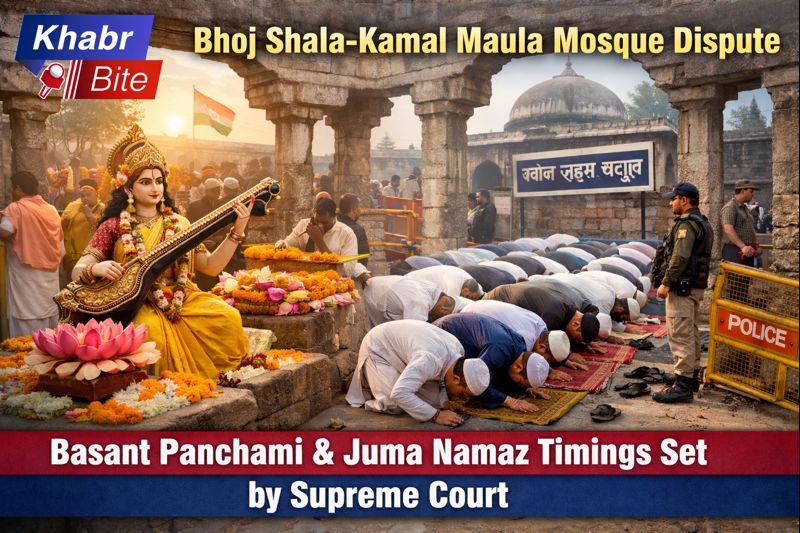
The Supreme Court of India has issued a crucial order in the Bhoj Shala-Kamal Maula Mosque dispute. Due to a rare calendar coincidence, the Hindu festival of Basant Panchami and the Muslim’s Juma Namaz fall on Friday, January 23, 2026. Now the court has intervened to ensure that both communities can exercise their religious right with a resolution of allowing both activities to take place on the same day, but at different times.
The Supreme Court’s Decision on Bhoj Shala–Kamal Maula Mosque Dispute Explained
On January 22, 2026, the bench comprising Chief Justice Surya Kant, Justice Joymalya Bagchi, and Justice Vipul M. Pancholi ordered a coordinated worship schedule for Friday, January 23.
The Supreme Court has asked Hindus to perform prayers from sunrise to sunset, and Muslims can offer Namaz between 1:00 PM and 3:00 PM. This decision has allowed both the Hindu and Muslim communities to perform their religious activity at the Bhoj Shala on the upcoming Friday.
Also Read: Strongest Solar Radiation Storm in Over 20 Years Hits Earth: Why Scientists Are Concerned
This decision was needed because a major Hindu festival dedicated to Goddess Saraswati and a day of congregational Muslim prayers (Juma Namaz) fall on the same day, Friday, January 23, 2026.
Fixed Worshipping Timing and Arrangements
Hindus are permitted to perform prayers and rituals from sunrise to sunset on Basant Panchami. Muslims are permitted to offer namaz between 1:00 PM and 3:00 PM on the same day. A significant logical arrangement has been made to ensure smooth functioning.
The court has directed that a separate and exclusive area within the compound be allocated for Namaz. Along with that, separate entry and exit points will be set to prevent the two groups from clashing.
Also Read: Donald Trump Shares Controversial Map Claiming Canada, Venezuela, and Greenland as U.S. Territory
The court has also directed the Muslim community to provide a list of persons attending the namaz to the district administration in advance. Additionally, the administration has the authority to issue passes to worshipers. This is to ensure that only authorized individuals enter the premises.
| Feature | Hindu Community (Basant Panchami) | Muslim Community (Juma Namaz) |
|---|---|---|
| Worship Timings | Sunrise to Sunset | 1:00 PM to 3:00 PM |
| Location | Designated space within the compound | Exclusive/Separate area within the compound |
| Entry & Exit | Dedicated separate points | Dedicated separate points |
| Requirement | Cooperation with local administration | Pre-approved list of persons for administration |
| Security Measure | Monitoring by District Administration | Entry via official passes (as needed) |
The bench has also made a formal appeal to both communities to maintain mutual respect and trust for each other. More importantly, they are asked to cooperate with the state authorities.
Context of the Bhoj Shala–Kamal Maula Mosque Dispute
The Bhoj Shala complex, an 11th-century monument, is the topic of the dispute between the Hindu and Muslim communities. Notably, the monument is protected by the Archaeological Survey of India (ASI), and the Hindus believe it is a temple dedicated to the Vagdevi (Goddess Saraswati) built by King Bhoja.
Muslims, on the other hand, identify it as the Kamal Maula Mosque.
Reportedly, historical research (Indian and foreign) indicates that the Bhoj Shala complex (including the Vagdevi temple) existed centuries before the Kamal Maula Mosque.
Radheshyam Yadav, former convenor of Hindu Jagaran Manch’s Indore division, claims that the mosque was built after destroying the ancient Hindu temples.
In 2003, an arrangement was made under a standing ASI order. Under which Hindus were allowed to worship on Tuesdays and Muslims were allowed to offer Namaz on Fridays. On Basant Panchami, Hindus had the full day access, but the 2003 order did not mention any arrangement when the festival falls on a Friday.
Now, as the Basant Panchami fell on Friday this year, an application has been filed by the Hindu Front for Justice seeking permission to allow day-long rituals. The bench has decided that both groups will be able to perform their religious activities on the same day, January 23, but at a fixed time.
Additionally, the court has also directed the High Court to unseal the ASI scientific survey report and share it with both the Hindu and Muslim groups.
Notably, the Court has brought a resolution for the Basant Panchami & Namaz dispute. However, the legal battle over the true character of the monument (Bhoj Shala–Kamal Maula Mosque dispute) continues.
