

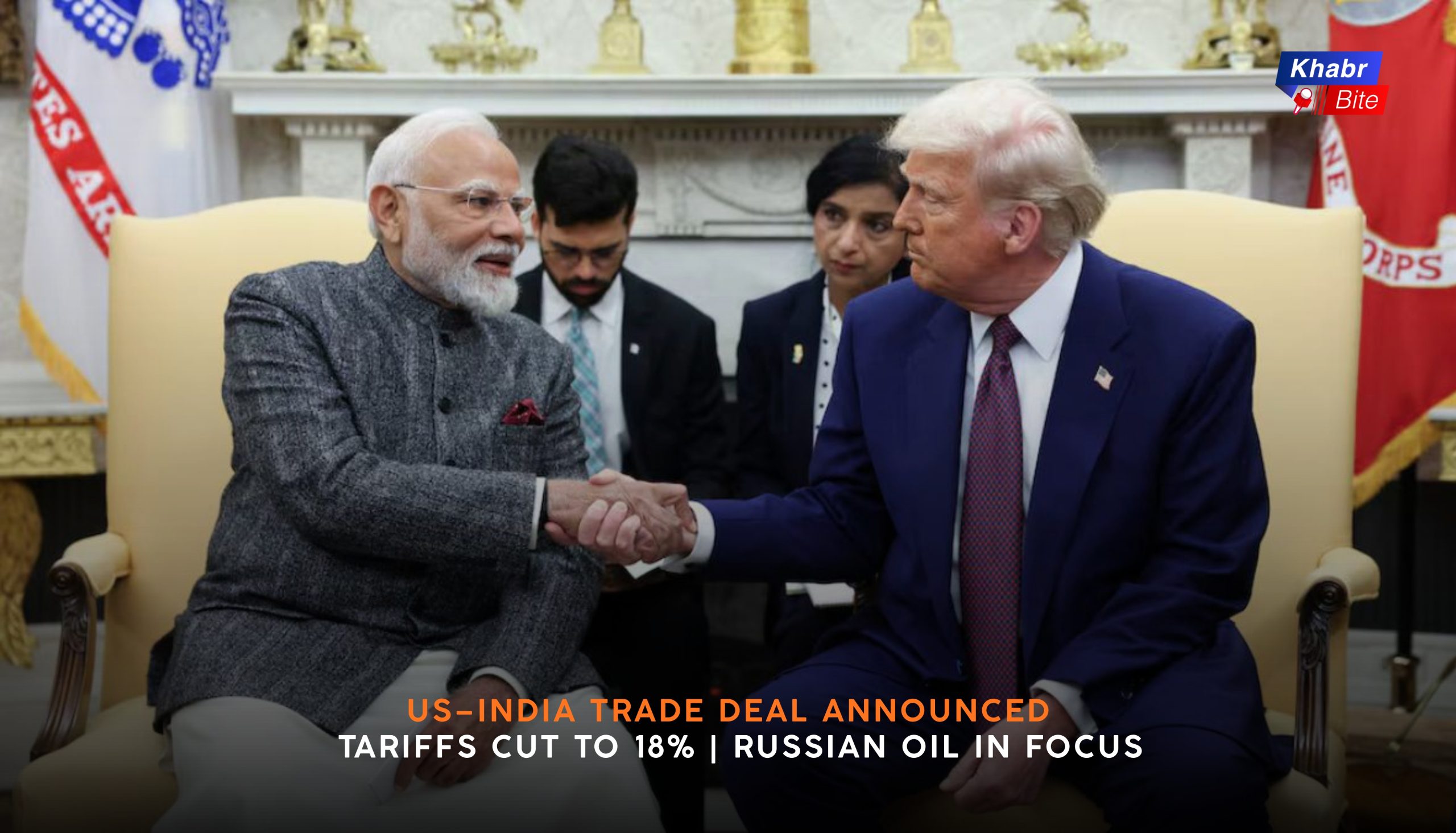
India has been facing an intense trade deal friction with the US, which has implemented a high (50%) tariff on Indian goods. Now that a breakthrough has finally come, with U.S. President Donald Trump announcing reduced tariffs on India post his phone call with Prime Minister Narendra Modi. Here are the details.
What is the new US-India Trade Deal?
On February 22, 2026, Trump and Modi held a phone call, leading to the immediate reduction of tariffs on Indian goods. Notably, Trump announced that he was cutting tariffs on Indian goods from a high of 50% to 18% in the US-India trade deal.
Previously, it has been 25% reciprocal tariffs and another 25% tariff for the purchase of Russian Oil. Prime Minister Modi posted on X that he is thankful to Trump on behalf of the nation for this reduced tariff.
“Wonderful to speak with my dear friend President Trump today. Delighted that Made in India products will now have a reduced tariff of 18%. Big thanks to President Trump on behalf of the 1.4 billion people of India for this wonderful announcement.”
Key Pillars of the US-India Trade Deal
Although there are these social media announcements, the Union Minister of Commerce and Industry, Piyush Goyal, added that the US-India trade deal is in the final stage of detailing and negotiations.
A joint statement will be made once the deal is finalised, and it will be shared.
“The trade deal is in the final stages of detailing between the negotiating teams of both countries. We will be issuing a joint statement by both countries shortly, along with the details which we will be shortly inking between the U.S. and India. As soon as the final understanding of the deal is inked and the joint statement is finalised, technical processes are completed, and full details will be shared.”
For now, it is reported that India will see reduced tariffs from 50% to 18%. Additionally, Trump claimed that India has agreed to zero tariffs and non-tariff barriers on U.S. products, along with committing to buy over $500 billion in U.S. energy, technology, agriculture, and coal.
The reduction in tariff is associated with India reportedly agreeing to stop purchasing the Russian oil, which cost them 25% tariffs from the US. There are also reports that, instead of Russia, India will now buy from the U.S. and Venezuela.
Also Read: Why the US Attacked Venezuela: What Happened, Reasons Behind the Strike, and Global Reaction
| Agreement Aspect | Details |
| U.S. Tariff Cut | Tariffs on Indian goods reduced from 50% (total) to 18%. |
| Indian Reciprocity | Trump claimed India pledged to move toward “Zero” tariffs and non-tariff barriers on American products. |
| Energy & Oil | India reportedly agreed to stop purchasing Russian oil and shift purchases to the U.S. and potentially Venezuela. |
| Purchase Commitment | India is committed to buy over $500 billion in U.S. energy, technology, agriculture, and coal. |
How will this Trade Deal Impact Both Countries?
Positive Impact on India
This trade deal will help India beat its neighbors (Vietnam, Bangladesh, and Indonesia), which have nearly 20% tariffs. More importantly, Chinese goods are facing 34% or higher tariffs, which will make India the preferred low-cost alternative for the U.S. market.
Experts suggest that labor-intensive sectors like jewelry, textiles, and leather will see an immediate surge in orders. This will create jobs for Indians.
Interestingly, the Indian currency, Rupee saw an immediate gain on the announcement of the US-India trade deal. Nifty 50 also saw a 4.8% surge right after the news.
Negative Impact on India
The U.S. does not just expect India to reduce Russian oil purchases but to stop them completely. A sudden stoppage of cheap Russian oil would lead to inflation and a surge in domestic fuel prices.
The Indian refineries (optimized for Russian grades) will also feel the impact as they will have to pivot to American and potentially Venezuelan crude.
Now, U.S. farmers are expected to gain unprecedented access to the Indian market, which was previously protected. There’s some dissatisfaction with this claim, but experts assert that the deal would not compromise on Indian farmers’ interests.
Impact on the U.S.
The U.S. will heavily benefit from India’s “zero-barrier” commitment as it opens up a previously protected market for American businesses. Per Trump’s claim, India has also committed to $500 billion worth purchase of U.S. energy (LNG/Coal), technology, and aircraft.
More importantly, they have now pulled India away from Russian oil, strengthening its sanctions regime. Trump reasons that this move will cut Russia’s primary revenue stream and end the war with Ukraine.
Also Read: Union Budget 2026: What Gets Cheaper and Costlier After Budget Announcements
Will India Really Stop Buying Cheaper Russian Oil?
Since the US-India trade deal is still in the discussion phase, there’s no clarity on whether India will completely stop buying oil from Russia. Experts from the Atlantic Council believe it is unlikely that India will stop due to economic, diplomatic, and strategic reasons.
Instead, they believe a significant decline in the purchase might happen, since India has already reduced its imports of Russian oil due to the US sanctions on Russia.