

The Ministry of Home Affairs (MHA) has issued a landmark notification regarding the protocol for Vande Mataram, India’s National Song. The Center has directed the first-ever formal set of rules for its rendition, mandating the full version of the song (six stanzas) as a primary protocol for national observance. However, there’s a certain debate on this topic.
MHA Guidelines on Vande Mataram
Vande Mataram, written 150 years ago by Bankim Chandra Chattopadhyay, is recognized as the National Song of India. In an order dated January 28, 2026, the Union Home Ministry directed that not two but all six stanzas (3 minutes 10 seconds long) shall be sung on official government events, schools, etc.
Also, if it’s sung with the National Anthem, Jan Gana Mana, and Vande Mataram would come first.
“When the National Song and the National Anthem are sung or played, the National Song will be sung or played first,” the order read.
More importantly, the assembly where the National Song is sung shall stand at attention. The same is not needed in the course of a newsreel or documentaries in which the National Song is used.
Also Read: Samsung Galaxy S26 Ultra Launch Date, Specs & What to Expect in 2026
Where can the National Song, Vande Mataram, be sung?
The order clearly stated that on all the occasions where the National Song is sung, it has to be the official version (six stanzas). It should be accompanied by mass singing on various occasions, with or without the accompaniment of instruments.
“The National Song may be sung on occasions which, although not strictly ceremonial, are nevertheless invested with significance because of the presence of Ministers etc. The singing of the National Song on such occasions [with or without the accompaniment of instruments], accompanied by mass singing, is desirable,” it said.
It is noted in the order that the complete list, where it may be sung, is not possible, but still lists some: –
- On the unfurling of the National Flag
- On cultural occasions or ceremonial functions other than parades
- On the arrival and departure of the President and Governors at any government or public function
- At civilian award ceremonies
- In schools, during morning prayers, etc.
Why is there a Debate on the Full Version of Vande Mataram?
Bankim Chandra Chattopadhyay wrote the highly Sanskritised Bengali, Vande Mataram, in the 1870s and published it in a novel called Anandamath during the Sannyasi Rebellion. The song moved beyond literature and became a crucial part of India’s freedom struggle.
It was sung by Rabindranath Tagore at an Indian National Congress session in 1896. Ever since its introduction, the last four stanzas were excluded as the Indian National Congress sensed those are unsuitable for a religiously diverse country like India, since the lines invoke Hindu goddesses.
Also Read: Your Income Tax Filing in 2026 Will Look Different – Govt Releases New Draft Rules
Before independence, some Muslim leaders had raised concerns, and later, only the first two stanzas, focusing on the motherland’s natural beauty, and less religious in imagery, got approved for the National Song.
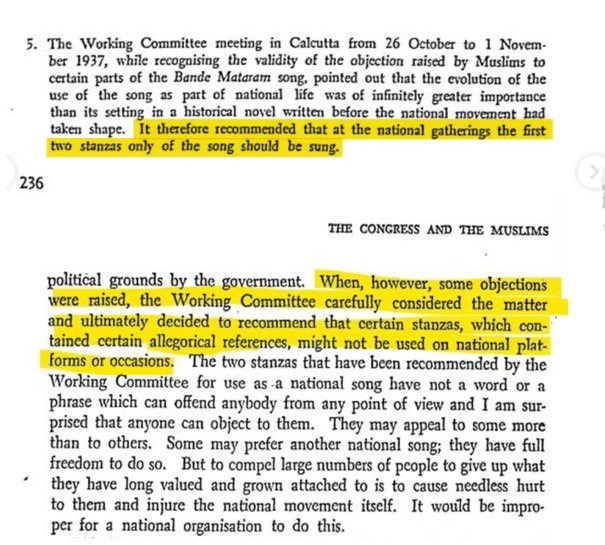
The core debate is based on the inclusion of these last four stanzas. Critics argue that the usage of full songs at school, government functions, or public events may alienate minority communities like Muslims and Christians.
Additionally, they suggest that the national symbols should not favour a single religion. The opposition leaders have also spoken against the MHA guideline on Vande Mataram, calling it an attempt to rewrite history.
On the other hand, the ruling party claims that the last four stanzas “sowed the seeds of partition,” which is why their inclusion is important to honor India’s freedom struggle.