
Last Updated on January 19, 2026 by Khabr Bite
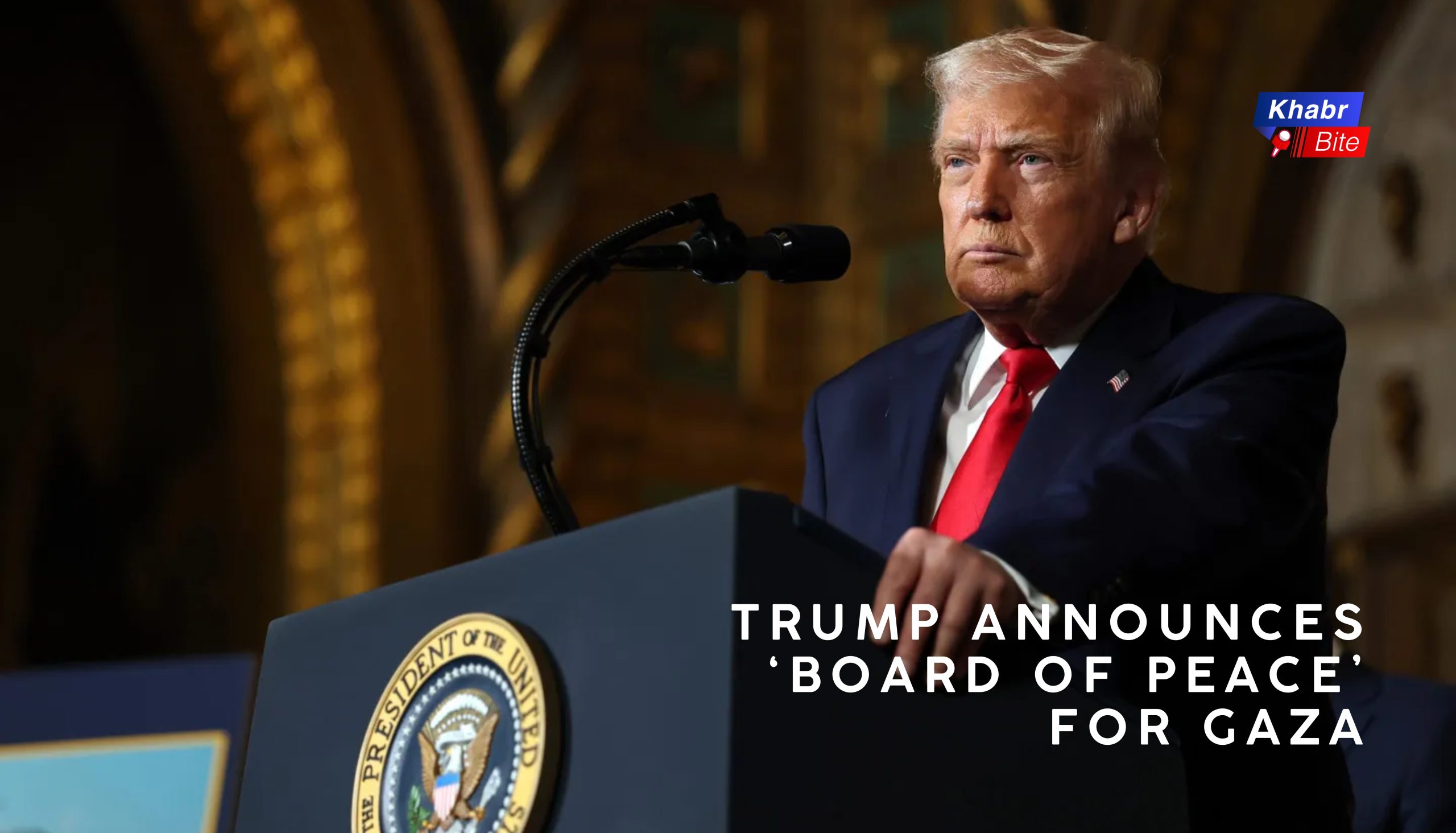
On Thursday, 15 January 2026, U.S. President Donald Trump announced the formation of the Gaza “Board of Peace” (BoP). This BoP is the cornerstone of “Phase Two” of Trump’s 20-point peace plan, which is designed to oversee the reconstruction, governance, and stabilization of the Gaza Strip following the 2025’s cease fire.
Through a Truth Social post, Trump has called this body “the Greatest and Most Prestigious Board ever assembled at any time, any place.”
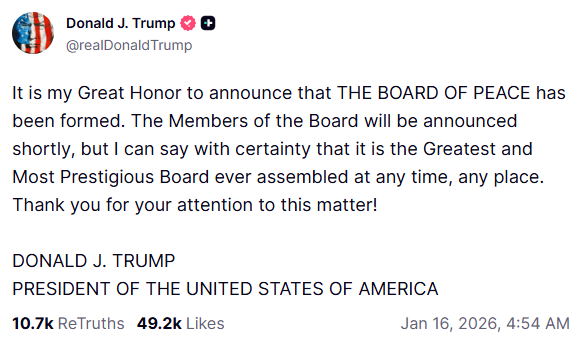
Source: Truth Social Post
Members and Leaders of the Trump Board of Peace
According to the White House, Donald Trump himself will act as the chairman of the Board of Peace, consisting of a “founding executive board” of high-profile political and financial figures.
The founding members of the Board of Peace are: –
- US Secretary of State Marco Rubio
- Steve Witkoff
- Jared Kushner
- Former UK Prime Minister Sir Tony Blair
- Marc Rowan
- Ajay Banga
- Robert Gabriel
Gaza’s Executive Board Members: –
Apart from the founding member, a Gaza Executive Board has been formed. The board will support governance and improve services for the people of Gaza.
- Steve Witkoff
- Jared Kushner
- Turkish Foreign Minister Hakan Fidan
- Ali Al-Thawadi, General Hassan Rashad
- Sir Tony Blair, Marc Rowan
- UAE Minister Reem Al-Hashimy
- Nickolay Mladenov
- Yakir Gabay
- Sigrid Kaag
Senior Advisors of the BoP are: –
- Aryeh Lightstone
- Josh Gruenbaum
Nickolay Mladenov (an executive board member) will serve as the High Representative for Gaza
| Role | Individual |
|---|---|
| Chairman | Donald Trump |
| Founding Members | Marco Rubio (US Secretary of State), Tony Blair (Former UK PM), Jared Kushner, Steve Witkoff (US Special Envoy), Ajay Banga (World Bank President), Marc Rowan (CEO of Apollo Global Management), Robert Gabriel (US Deputy NSA) |
| Gaza’s Executive Board Members | Members of this executive board include Steve Witkoff, Jared Kushner, Turkish Foreign Minister Hakan Fidan, Ali Al-Thawadi, General Hassan Rashad, Sir Tony Blair, Marc Rowan, UAE Minister Reem Al-Hashimy, Nickolay Mladenov, Yakir Gabay, and Sigrid Kaag. |
| High Representative for Gaza | Nickolay Mladenov (Former UN Middle East envoy) |
| Senior Advisors | Aryeh Lightstone and Josh Gruenbaum |
The Two-Tiered Governance Structure of the Board of Peace
Notably, the Board of Peace will act as a high-level supervisory body. It is divided into two structures: the National Committee for the Administration of Gaza (NCAG) and the International Stabilization Force (ISF).
However, a separate entity will monitor the day-to-day administration of Gaza.
National Committee for the Administration of Gaza (NCAG)
To handle the daily civilian matters in Gaza, a national committee consisting of 15 members has been created. This Palestinian technocratic committee, led by Ali Sha’ath, a Gaza native and former Palestinian Authority official, will restore public services like healthcare, electricity, food distribution, and maintain public order.
International Stabilization Force (ISF)
An International Stabilisation Force led by US Major General Jasper Jeffers is also proposed to be deployed in Gaza. Its role would be to maintain security and train approved Palestinian police officers to prevent renewed violence.
Also Read: India Faces Another 25% Levy With Trump’s New Iran Tariff, Here’s Everything You Need to Know
Key Objectives of BoP and Phase Two
Trump has officially confirmed that the Board of Peace (BoP) marks the beginning of the next phase of Gaza’s 20-point Peace Plan. It is expected to oversee the Governance of Gaza after the war and guide key political and security decisions during the transition periods.
It will also supervise the implementation of a broader peace plan in addition to coordination with the US, international partners, and regional partners.
Phase Two’s key objective includes: –
- Reconstruction of the destroyed infrastructure with international funding and private investment.
- Ensuring the full disarmament of “unauthorized personnel” (Hamas), as it is a non-negotiable demand from Israel.
- Establishing a transitional governance (self-sustaining civilian administration under the NCAG).
- Another key objective is to coordinate with Egypt, Jordan, and other regional partners to maintain a “terror-free” environment.
While the UN Security Council Resolution (2803) formally backs the plan, there are also hurdles. There’s still disagreement with Hamas over full disarmament and a fragile ceasefire. The reports of sporadic violence and aid shortages could complicate the transition to Donald Trump’s second phase.
Also Read: Trump Signals Possible US Action as Iran Protests Escalate; Israel on High Alert
